
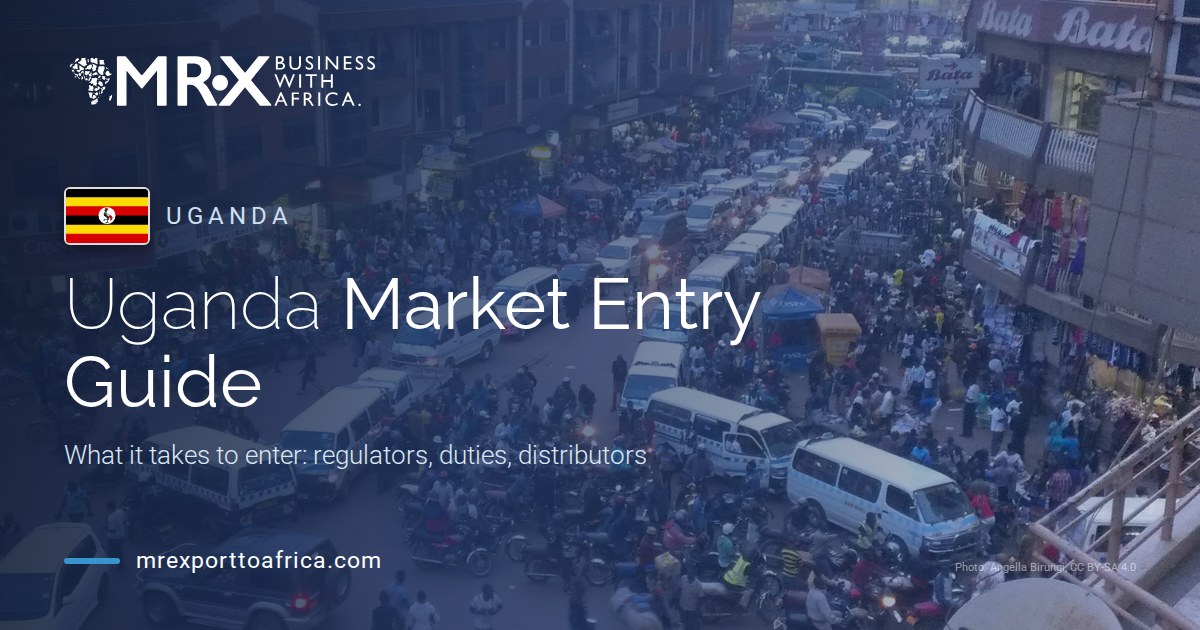
Entering Uganda takes a UNBS Certificate of Conformity for every consignment under compulsory standards, and one Kampala distributor with real vans and sub-distributor coverage, not a chase for oil contracts.
Uganda's first oil is arriving, and the reflex it triggers in most exporters is the wrong one. The reflex is to chase the oil: register as a vendor, hunt the package, wait. Meanwhile Uganda has nearly fifty million people who buy soap, food, cable, tyres and roofing every week, and the oil money is making more of them able to pay for it.
The oil is not your customer. It is your customer's customer. This guide covers what we check before recommending Uganda to a manufacturer looking for a distributor.
Why Uganda
A large, young consumer market, a Kampala trade that already supplies neighbouring countries, and a currency regime that makes getting paid simpler than almost anywhere else in the region. If payment risk is what has kept you out of Africa, Uganda is where you test the thesis.
Where the money is coming from
Tilenga and Kingfisher are coming on stream in 2026, around 230,000 barrels a day between them, with the export pipeline more than 90 percent welded. The Petroleum Authority says 2.3 billion dollars of contracts have already gone to Ugandan companies and over 21,000 jobs have been created.
Hoima and Buliisa are now wage towns. Kampala takes the salaries. Neither of those needs you to win a tender.
Who you actually sell to
Kampala, and one house in it.
Distribution houses
Mukwano is the industrial anchor, making and moving cooking oil, soaps, detergents and plastics across the region. Charms Uganda runs a proper FMCG distribution operation, route vans plus twelve sub-distributors reaching every outlet type. Hariss International dominates beverages.
Formal retail
Capital Shoppers, the largest locally owned chain, along with Quality Supermarket and Carrefour. Useful for credibility, not for volume. Volume is the wholesaler and the duka.
The second question
Kampala is the supply base for South Sudan through Elegu, and for eastern Congo. A distributor already working those borders sells your container twice.
| Company | Type | Detail from the guide |
|---|---|---|
| Mukwano | Industrial anchor | Makes and moves cooking oil, soaps, detergents and plastics across the region |
| Charms Uganda | FMCG distribution | Route vans plus twelve sub-distributors reaching every outlet type |
| Hariss International | Beverages | Dominates beverages |
| Capital Shoppers, Quality Supermarket, Carrefour | Formal retail | Useful for credibility, not for volume |
Before you quote
Pre-export verification
Products under compulsory Ugandan standards need a Certificate of Conformity for every consignment, issued before shipment by a UNBS-appointed inspector. No certificate, no clearance.
The small consignment exemption
Consignments under 2,000 dollars are exempt, but get inspected on arrival instead. Do not use that as a shortcut for a first order.
Oil and gas ring-fencing
In oil and gas, transport, security, catering, fuel supply, clearing and waste are ring-fenced for Ugandan companies. Another reason the invoice should carry a Ugandan name, not yours.
Getting paid
This is where Uganda beats almost every other market we cover. The shilling floats freely and there are no exchange controls. No allocation queue, no central bank permission, no waiting.
Money comes in and goes out the same day. It was called the world's most stable currency in 2025, and reserves have been rebuilt.
That leaves the ordinary credit questions: payment terms earned through a record, and a first order small enough to survive being wrong.
What to ask before you sign
- How many vans and sub-distributors do you run, and which outlets do they reach? Coverage is the product you are buying.
- What do you already move into South Sudan through Elegu, and into eastern Congo? Price that volume into the agreement.
- Who arranges the UNBS Certificate of Conformity with our inspector? Agree it before the first quote, so every consignment is covered.
- Which brands do you carry, and may we call two of them? Then agree exclusivity tied to volume and a first order small enough to survive being wrong.
The mistakes that cost exporters their first year
- Spending a year chasing oil packages instead of selling to the consumers and contractors the oil money pays.
- Loading before the UNBS Certificate of Conformity is issued.
- Using the under 2,000 dollar exemption to skip verification on a first order, then meeting inspection on arrival.
- Appointing a distributor for their supermarket listings rather than their vans and wholesale coverage.
- Not asking what the distributor already moves into South Sudan and eastern Congo, and pricing that out of the deal.
How MRX supports Uganda entry
MRX runs market entry for exporters across Sub-Saharan Africa, with ground teams in the region, Uganda included, and delivery managed from Athens and Zambia. For Uganda we confirm the UNBS path for your product, shortlist and vet Kampala distributors by real coverage, with the ones who actually pay marked, and support negotiation through to first orders. The first move: one Kampala distributor with real vans and real coverage, certificates settled before the quote, cross-border volume priced in, exclusivity tied to volume.
Entry steps
- Confirm the UNBS path for your product.
- Shortlist and vet Kampala distributors by real coverage.
- Settle certificates before the quote and price cross-border volume in.
- Appoint one distributor with exclusivity tied to volume and a first order small enough to survive being wrong.
Frequently asked questions
Do I need a Certificate of Conformity to export to Uganda?
Yes, for products under compulsory Ugandan standards. Each consignment needs a Certificate of Conformity issued before shipment by a UNBS-appointed inspector. Consignments under 2,000 dollars are exempt but are inspected on arrival instead.
Should I register as a supplier to Uganda's oil projects?
For most manufacturers, no. Many oil and gas service categories are ring-fenced for Ugandan companies, and the larger opportunity is the wage economy the projects create in Kampala, Hoima and Buliisa, reached through Ugandan distributors.
Are there exchange controls in Uganda?
No. The shilling floats freely and there are no exchange controls, allocation queues or central bank permissions, so payments move the same day.
Can a Ugandan distributor reach neighbouring markets?
Often, yes. Kampala is the supply base for South Sudan through Elegu and for eastern Congo. Ask what a distributor already moves across those borders and price it into the agreement.
Which Ugandan distributors are named in this guide?
Mukwano (industrial anchor), Charms Uganda (FMCG distribution with route vans and twelve sub-distributors) and Hariss International (beverages), plus the retail chains Capital Shoppers, Quality Supermarket and Carrefour.