
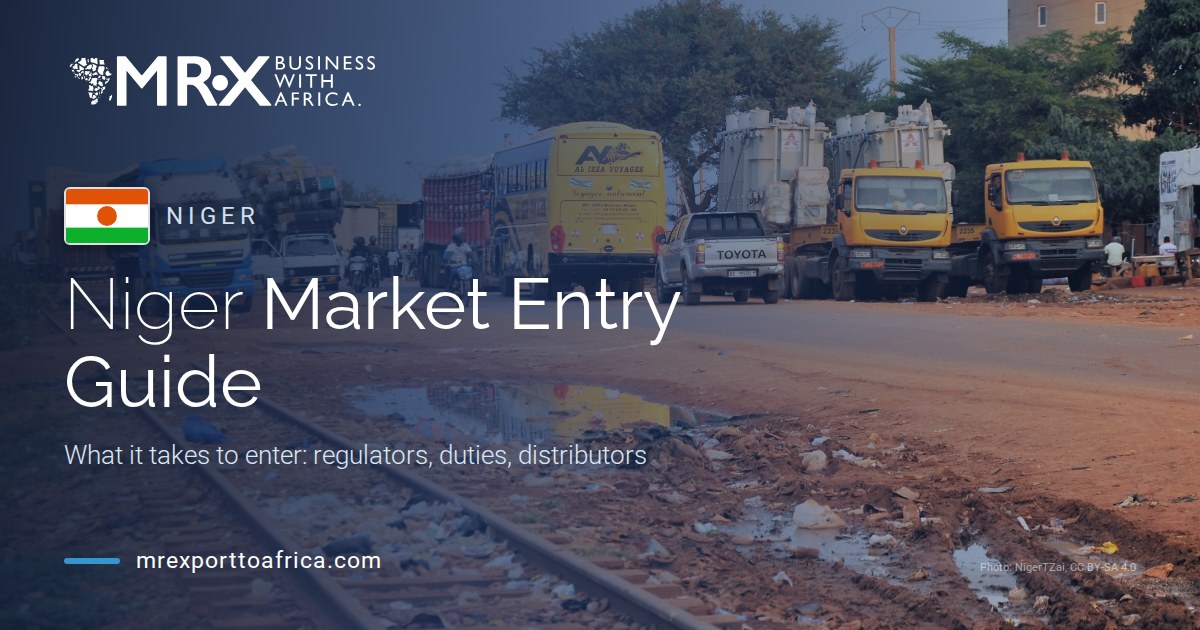
Entering Niger takes a landed-cost model on the current tariff regime priced through Lome, one Niamey importer who clears their own cargo, and patience: for most manufacturers the honest first move is to prepare now and ship when two of three signals appear.
Most of our market entry guides end with a first move. For Niger, our honest first move for most manufacturers is to prepare now and ship when three specific signals appear. Niger has a growing economy, real money arriving and underserved shelves.
What it does not yet have is a reliable route for goods to reach the people with that money. This guide explains exactly what changed, how to enter if you decide to go now, and what would move Niger from wait to worth a trip.
What changed, and why an old duty calculation is wrong
Niger left ECOWAS in January 2025 alongside Mali and Burkina Faso. The ECOWAS common external tariff no longer applies. Trade now runs on most favoured nation rates, and the Alliance of Sahel States added a levy on goods entering the bloc.
If you modelled Niger's landed cost from an ECOWAS tariff schedule, that number is not just old. It is the wrong document. Start any Niger quotation from the current regime.
The route question
Between 70 and 80 percent of Niger's imports used to arrive through the port of Cotonou. That border has now been shut into a third year.
Cargo goes another way. Lome to Niamey is roughly 1,200 kilometres. The alternative detours through northwestern Nigeria, which adds several hundred kilometres and a third customs jurisdiction to the same journey.
Every additional border is a cost, a delay and a decision made by someone you have never met. That is the part no spreadsheet catches, and it is why the route, not demand, decides Niger today.
| Route | Status | Detail from the guide |
|---|---|---|
| Cotonou, Benin | Closed | Used to carry 70 to 80 percent of imports; border shut into a third year |
| Lome to Niamey | In use | Roughly 1,200 kilometres |
| Via northwestern Nigeria | Alternative | Adds several hundred kilometres and a third customs jurisdiction |
Why serious exporters are watching
Oil is flowing at close to 106,000 barrels a day through a 1,950 kilometre pipeline, growth is forecast near 6.7 percent, and once the loan against that oil is repaid the great majority of the revenue returns to the national budget rather than to a lender.
There is real money arriving. The opportunity is not in question. Getting goods to the people who have it is the mechanic to solve.
The competitor you cannot see
With the formal corridors squeezed, a large share of goods now moves informally. That matters to you for one reason.
If your distributor's rival lands the same product outside the system, your correctly declared container arrives dearer than theirs. Ask what the street price is before you set yours.
If you go now: the mechanics
- Price landed Niamey through Lome and quote nothing else.
- Arrange your cargo tracking documentation before loading, not at the port.
- Appoint one Niamey importer who clears their own cargo rather than subcontracting it.
- Sell private and take payment terms you would accept from a stranger, because commercially that is what you have.
The three signals that change the answer
The Benin border formally reopening. Talks reached a first milestone in June 2026.
The pipeline running a full year without interruption.
A published, stable tariff schedule you can actually quote against.
Any two of those and Niger moves from wait to worth a trip. Until then, the same effort spent in Ghana or Senegal returns more, and a partner relationship built in the region now puts you in position for Niger when it opens.
What to ask before you sign
- Do you clear your own cargo? On a route with this many borders, subcontracted clearance is where delays and costs multiply.
- Which route do you use today, and what does it cost to Niamey? A partner already moving goods through Lome will give you a real landed number.
- What is the street price of competing goods? If informally landed product sets the price, you need to know before you quote.
- What payment terms will you accept? Start with terms you would accept from a stranger, and relax them only as a payment record builds.
The mistakes that cost exporters their first year
- Quoting from an ECOWAS tariff schedule that no longer applies.
- Pricing via Cotonou as if the border were open.
- Setting a price without checking the street price of informally landed competition.
- Leaving cargo tracking documentation to the port.
- Appointing an importer who subcontracts clearance on a route with this many borders.
How MRX supports Niger entry
MRX runs market entry for exporters across Sub-Saharan Africa, with ground teams in the region and delivery managed from Athens and Zambia. Telling you when not to ship is the same job as telling you where to.
For Niger we model your landed cost through Lome on the current tariff regime, check the street price, and, when the signals line up, shortlist Niamey importers who clear their own cargo. In the meantime we will point you to the West African markets that are ready now.
Entry steps
- Model your landed cost through Lome on the current tariff regime.
- Check the street price of informally landed competing goods.
- Arrange cargo tracking documentation before loading.
- When the signals line up, appoint one Niamey importer who clears their own cargo.
Frequently asked questions
Does the ECOWAS tariff still apply to exports to Niger?
No. Niger left ECOWAS in January 2025. Trade now runs on most favoured nation rates, and the Alliance of Sahel States adds a levy on goods entering the bloc.
What is the main shipping route to Niger?
With the Benin border shut, cargo mostly runs from Lome to Niamey, roughly 1,200 kilometres. The alternative through northwestern Nigeria adds several hundred kilometres and a third customs jurisdiction.
Is now the right time to enter Niger?
For most manufacturers, preparation is the right move now. Niger moves from wait to worth a trip when two of three signals appear: the Benin border formally reopening, the oil pipeline running a full year without interruption, and a published stable tariff schedule.
How should exporters price for Niger?
Price landed Niamey through Lome, arrange cargo tracking documentation before loading, and check the street price of informally landed competing goods before setting yours.
What are the three signals that would change the answer on Niger?
The Benin border formally reopening (talks reached a first milestone in June 2026), the pipeline running a full year without interruption, and a published, stable tariff schedule you can quote against. Any two move Niger from wait to worth a trip.